How to Check a Second Hand Car: The Ultimate 2026 Inspection Guide
Buying a used vehicle can save you a ton of money, but only if you know exactly how to check a second hand car before making the payment. With rising cases of odometer tampering, hidden accident damage, and forged documents, relying solely on the seller's word is a recipe for disaster.
This comprehensive guide breaks down the professional inspection process into simple, actionable steps so you can evaluate any used car like an expert.
⚠️ The Cost of Skipping an Inspection
Failing to properly check a second hand car can lead to massive financial losses:
- ❌ Hidden Engine Issues: Engine rebuilds can cost upwards of ₹1,000,000
- ❌ Accidental Vehicles: Compromised structural integrity is a fatal safety risk
- ❌ Pending Loans: If the car is still hypothecated, the bank can repossess it from you
- ❌ Legal Troubles: Buying a car with a forged RC or pending police cases makes you legally liable
Table of Contents
1. Step 1: Legal Documents & History Check
Before you even look at the car physically, you must verify its legal standing. A flawless car is worthless if the paperwork is fraudulent.
- Vahan Portal Verification: Enter the registration number on the official Vahan portal. Ensure the owner's name, car model, and registration date match the seller's claims.
- Hypothecation (Loan) Status: Check the RC. If it shows "Hypothecated," the seller MUST provide a No Objection Certificate (NOC) from the bank. Without it, the bank legally owns the car.
- Service History: Demand the original service records from authorized service centers. A consistent service history proves the car was maintained and helps verify the odometer reading.
- Insurance Claims: Active insurance is mandatory. Look at the No Claim Bonus (NCB) percentage. A high NCB (like 40-50%) indicates the car hasn't had major accident claims recently.
2. Step 2: Exterior & Structural Integrity
A shiny exterior can hide serious structural flaws. Here is how to check a second hand car's bodywork for hidden accident damage:
Exterior Inspection Checklist
- Panel Gaps: Look at the gaps between the doors, hood, and fenders. Uneven gaps are a tell-tale sign of replaced panels after a crash.
- Paint Mismatches: Inspect the car under bright, natural daylight. Look for slight color variations or a wavy "orange peel" texture on certain panels, which indicates repainting.
- Original Glass: Check the manufacturer logos printed on the corner of all windows and the windshield. If one is an aftermarket brand, that glass was broken and replaced.
- Tire Wear: Uneven tire wear (e.g., bald on the inner edge but fine on the outside) points to severe suspension or alignment issues.
3. Step 3: Under the Hood (Engine & Mechanicals)
The engine is the heart of the vehicle. Replacing it can cost more than the car itself.
- Cold Start: Insist on starting the car when the engine is completely cold. Watch the exhaust—blue smoke means burning oil, and thick white smoke indicates a coolant leak (blown head gasket).
- Oil Check: Pull the dipstick. The oil should be golden or dark brown, but never milky or frothy (which means water is mixing with the oil).
- Unusual Noises: Listen closely for knocking, tapping, or grinding sounds while the engine idles. A healthy engine should have a smooth, consistent hum.
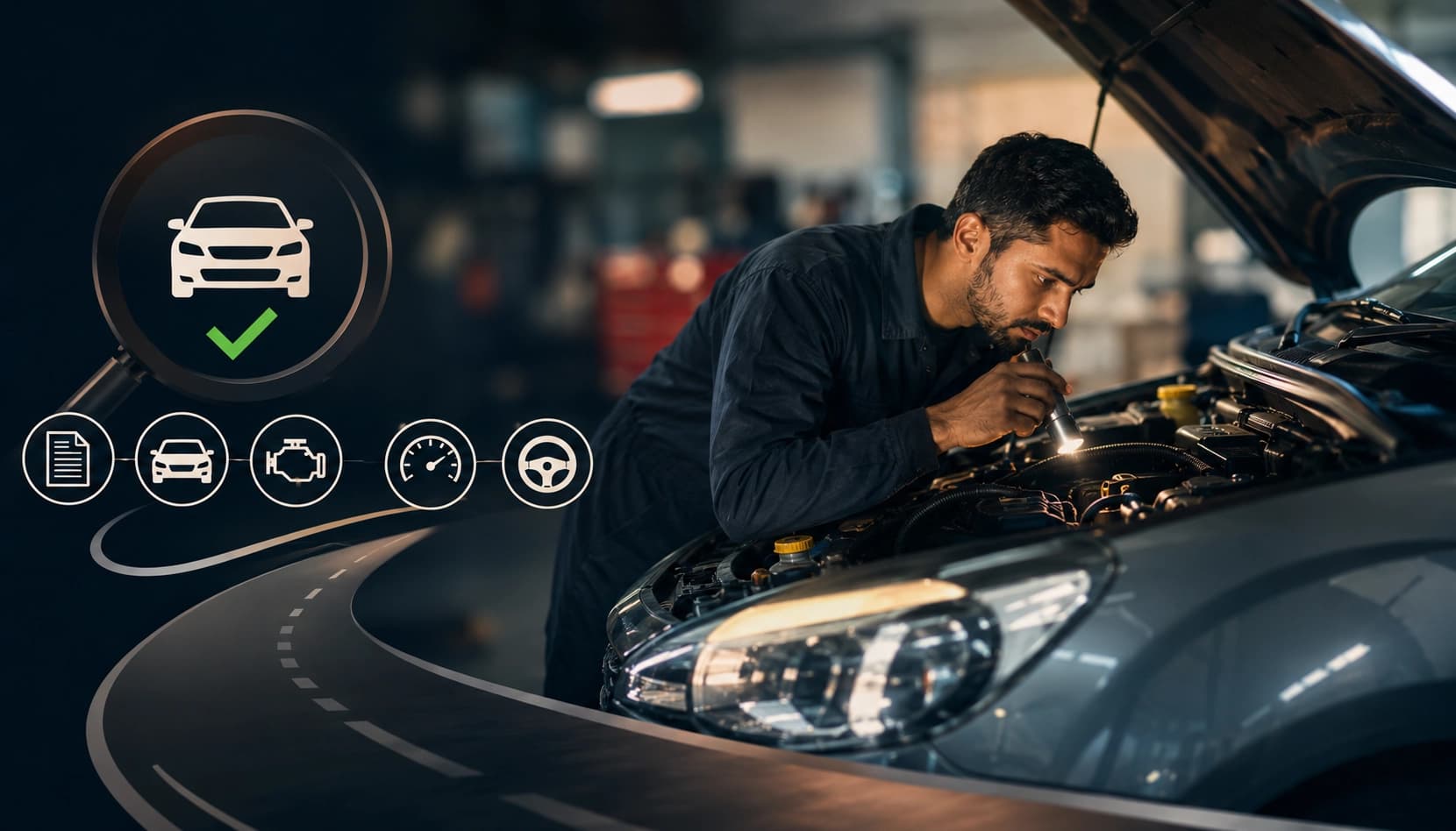
- Leakages: Look under the car and around the engine block with a flashlight. Wet, sludgy patches indicate oil or coolant leaks.
4. Step 4: Interior & Odometer Verification
Odometer tampering is the most common used car fraud. A car driven 150,000 km might be rolled back to 50,000 km to inflate its price.
🔍 Spotting Odometer Fraud
Look at the physical wear and tear. If the odometer says 30,000 km, but the steering wheel is shiny and smooth, the rubber on the brake pedal is worn down to the metal, and the driver's seat bolster is torn, the odometer has likely been tampered with. Wear and tear should match the mileage.
Inside the cabin, test absolutely every button. Check the AC (it should blow cold within 60 seconds), all power windows, the infotainment system, wipers, and lights. Electrical gremlins are notoriously difficult and expensive to fix.
5. Step 5: The Test Drive Checklist
Never buy a car without driving it for at least 5 to 10 kilometers through varied traffic conditions.
- Transmission: In a manual car, the clutch should not feel spongy or slip. In an automatic, gears should shift smoothly without jerking or hesitation.
- Suspension: Drive over speed bumps or rough patches. Listen for clunking noises. The car should absorb bumps smoothly, not bounce uncontrollably.
- Steering and Alignment: On a straight, empty road, loosen your grip on the steering wheel slightly. If the car pulls sharply to one side, the alignment is off or the chassis is bent.
- Braking: Brake firmly at a safe speed. The car should stop in a straight line without the steering wheel vibrating (which indicates warped brake rotors).
6. Need Professional Help with RC Transfer & Legal Verification?
While you should get a mechanic to check the engine, don't risk your money on forged documents or pending loans. Our automotive legal experts at MDNetwork can verify your used car's legal standing and handle RC transfers at Bhanpuri RTO.
Available: 10 AM - 2 PM (Bhanpuri RTO office hours) | Free consultation
7. Frequently Asked Questions
What is the most important thing to check in a second hand car?
The most important aspects are the engine's health (no unusual noises or leaks), the structural integrity (no frame welding or major accident damage), and the legal paperwork (clear RC and no active loan/hypothecation).
How can I tell if a second hand car's odometer has been tampered with?
Check the service history records for mileage progression, inspect the physical wear on the steering wheel, gear knob, and pedals, and cross-reference previous readings on the Vahan portal.
Should I get a professional to check the second hand car?
Yes, hiring a certified mechanic for a pre-purchase inspection (usually costing ₹500-₹1500) is highly recommended. It can save you from hidden damages that could cost lakhs to repair.
⚠️ Legal Disclaimer
This guide is for informational purposes only and does not constitute professional mechanical advice. Always verify current requirements with the official RTO and consult a qualified automotive professional before purchasing a used vehicle.
Last updated: June 2026
About Rajesh Sharma
"Rajesh has inspected over 1,500 used cars and helped buyers avoid millions in hidden repair costs and fraud. Certified by Automobile Dealers Association."